
It matches “” on the NSW urgent repairs list (Residential Tenancies Act 2010, s 62).
What to do first
- Tell the landlord or agent straight away, in writing if you can. Keep copies of messages and notes of calls.
- If you can’t reach them, or they’re unwilling or taking too long, check your lease for the tradesperson it names.
- You can then have a licensed tradesperson do the repair, preferably the one named on your lease.
- Send the landlord or agent written details of the repair with the receipts.
How much you can spend
Up to $1,000 in reasonable costs. The landlord or agent must pay you back within 14 days of your written notice. Spend more and you may not get the extra back.
When you might not be paid back
- You caused the damage.
- You didn’t try to contact the landlord or agent, or didn’t give them a reasonable time to organise the repair.
- The work wasn’t done by a licensed tradesperson.
Timelines
- Landlord or agent: NSW law doesn’t set a fixed number of days for most urgent repairs; the Tenants’ Union says the landlord or agent should attend to them as soon as possible.
- Not paid back? Apply to NCAT within 3 months (Tenants’ Union of NSW).
- Keep paying the rent while you sort it out.
NSW treats a faulty smoke alarm as urgent, with separate repair rules.
What to do first
- Tell the landlord or agent that the alarm isn’t working, even if it only needs a battery.
- The landlord must repair or replace it within two business days of finding out, including replacing a removable battery.
- A removable battery: most tenants (not social housing tenants) can choose to replace it themselves after telling the landlord. Follow the NSW steps.
- A hard-wired alarm: if it isn’t fixed within 2 business days, you can arrange a licensed electrician.
Getting paid back
You’re entitled to be reimbursed within 7 days if you paid for the repair or replacement after giving the landlord the chance to do it. Give written notice of the cost with copies of receipts.
NSW smoke alarm rules for rentals
It still needs fixing. NSW Fair Trading says non-urgent repairs need to be done to keep the property in reasonable condition.
What to do first
- Tell the landlord or agent in writing what needs fixing and by when. Give a clear deadline.
- Follow up if you don’t hear back within a reasonable time. Keep copies.
- Want to arrange it yourself? Get the landlord’s consent and their agreement to pay, both in writing, first. They should pay you back within 14 days.
If it isn’t done
- Make a complaint to NSW Fair Trading, which may issue a rectification order.
- Apply to NCAT within 3 months of the landlord missing your deadline (Tenants’ Union of NSW).
- Keep paying the rent.
Where to go next
- NSW Fair Trading: getting repairs done, or call 13 32 20
- Make a tenancy complaint to NSW Fair Trading
- NCAT tenancy applications
- Tenants’ Union of NSW repairs factsheet
- Southern Sydney Tenants Advice and Advocacy Service (Bankstown and Canterbury areas), (02) 9787 4679
Checked 6 October 2026. This checker covers the common cases and isn’t legal advice. NSW Fair Trading has the final say.
The short answer
In NSW an urgent repair is one on the list in the Residential Tenancies Act 2010, such as a burst water service, a gas leak, a dangerous electrical fault or no hot water. Tell the landlord or agent straight away. If they can’t be reached or don’t act, you can have a licensed tradesperson do it and claim back the reasonable cost, within the limit below.
Common repairs and how NSW treats them
Show all 26 problems in a table
“Urgent” follows the NSW Fair Trading wording of the s 62 list; the trade column is our guide to who usually does the work.
| Problem | Urgent under NSW law? | Who usually fixes it |
|---|---|---|
| Burst water pipe | Urgent | Licensed plumber |
| Tap, toilet cistern or hot water unit leaking or running on | Urgent if a substantial amount of water is being wasted | Licensed plumber |
| Blocked or broken toilet | Urgent | Licensed plumber |
| Roof leaking when it rains | Urgent if it’s a serious leak | Roofer or roof plumber |
| Flooding or serious flood damage | Urgent | SES, then licensed trades |
| Smell of gas or a gas leak | Urgent | Licensed gasfitter |
| Sparking, burning smell, exposed wiring or electric shocks | Urgent | Licensed electrician |
| Power point, switch or light fitting loose, cracked or not working | Urgent | Licensed electrician |
| No power, gas or water to the home | Urgent | Network operator or licensed trade |
| Smoke alarm not working, removed or beeping | Urgent | Landlord; licensed electrician if hard-wired |
| No hot water | Urgent | Licensed plumber (and electrician or gasfitter) |
| Stove, oven or cooktop not working | Urgent | Licensed electrician, gasfitter or service technician |
| Heater or air conditioner not working | Urgent | Licensed air conditioning technician |
| Laundry tap or tub not working | Urgent | Licensed plumber |
| Washing machine supplied with the home not working | Urgent | Washing machine service technician |
| Dishwasher, rangehood or another supplied appliance not working | Urgent if it’s wasting a substantial amount of water or unsafe to use | Licensed electrician, gasfitter or service technician |
| External door, lock or window broken so the home can’t be secured | Urgent | Locksmith or glazier |
| Cracked window glass (it still closes and locks) | Not urgent | Glazier |
| Serious storm or fire damage | Urgent | SES, then licensed trades |
| Something unsafe: loose balcony rail, sagging ceiling, collapsed step | Urgent | Licensed builder or specialist |
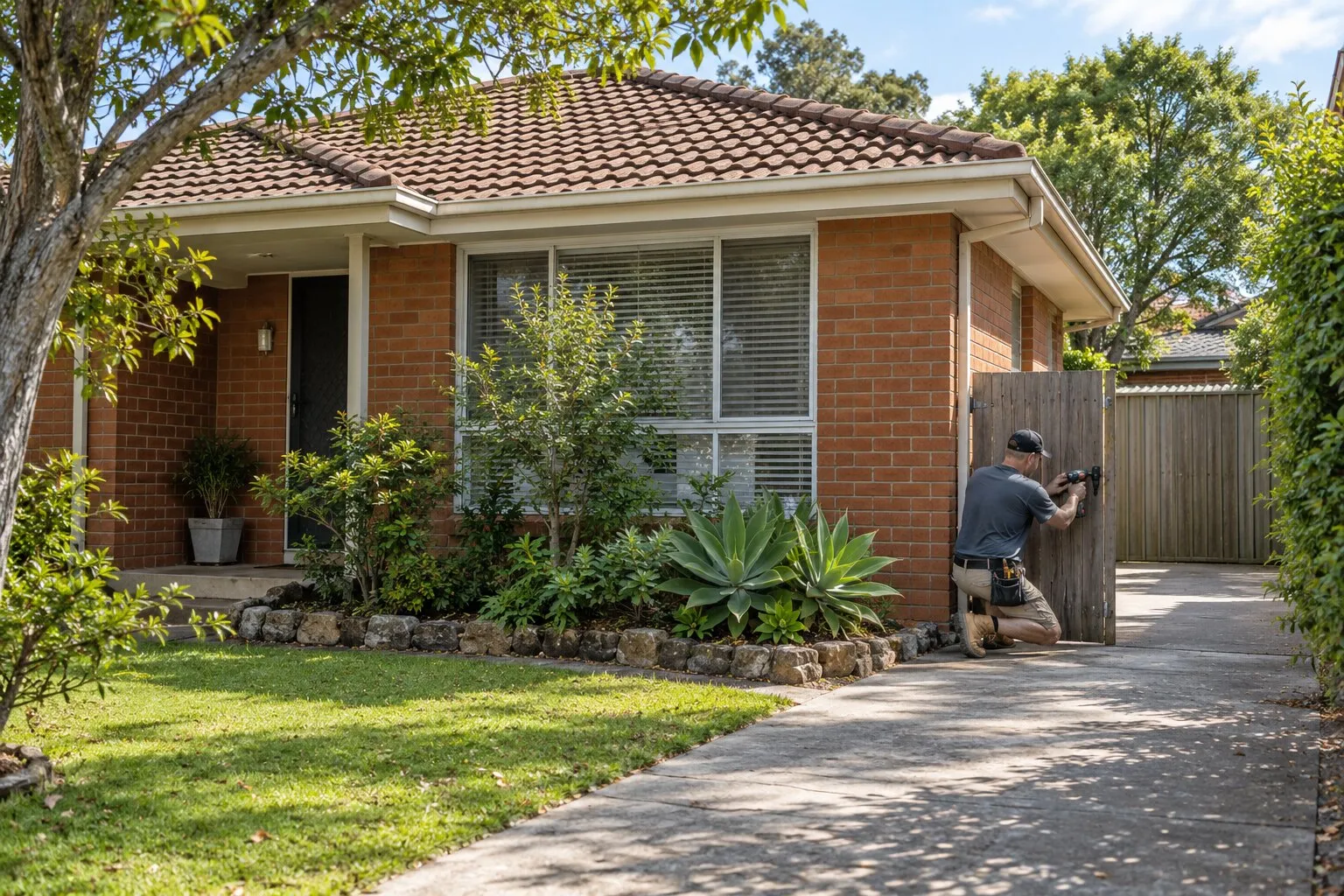
| Broken gate latch, hinge or fence palings | Urgent if it leaves the home unsafe or unable to be secured | Landlord or agent arranges a repairer; handyman if it isn’t a security or safety problem |
| Broken cupboard, drawer or handle | Not urgent | Handyman (minor work) |
| Internal door sticking, sagging or not latching | Not urgent | Handyman (minor work) |
| Torn or loose flyscreen | Not urgent | Handyman (minor work) |
| Small hole, dent or crack in an inside wall | Not urgent | Handyman (minor work) |
| Broken blind, curtain rod or track | Not urgent | Handyman (minor work) |
Source: NSW Fair Trading’s urgent repairs list and repairs guide, checked 6 October 2026. Where a problem depends on the answer to a question, the checker asks it.
What to do first when a repair is urgent
Tell the landlord or agent straight away, in writing if possible, and keep copies. If you can’t reach them, or they are unwilling or taking too long, check your lease for the tradesperson it names. If anyone is in danger, call 000 first. For a gas leak, Jemena’s gas faults and emergencies line is 131 909. Report a burst main in the street to Sydney Water on 13 20 90, and call the NSW SES on 132 500 for flood or storm help.
How much can a tenant spend on an urgent repair?
Up to $1,000. The landlord or agent must pay you back within 14 days of your written notice with receipts. The Tenants’ Union of NSW warns not to pay more than $1,000, because the landlord only has to repay reasonable costs up to that amount. You must be able to show the problem wasn’t your fault, that you made a reasonable attempt to contact the landlord or agent, that you gave them a reasonable chance to do the repair, and that the tradesperson named on your lease (if possible) or a licensed or qualified tradesperson did the work.
If you aren’t paid back, the Tenants’ Union says to apply to NCAT within 3 months. If you can’t afford to pay for an urgent repair, you can ask the Tribunal for an urgent hearing.
Non-urgent repairs: what to do
Write to the landlord or agent with what needs fixing and a clear deadline, and follow up if you don’t hear back. If you want to arrange the work yourself, get their consent and agreement to pay in writing first. If the repair still isn’t done, you can complain to NSW Fair Trading, which may issue a rectification order, or apply to NCAT.
Who should do the repair?
Plumbing, drainage, gasfitting, electrical, air conditioning and refrigeration work needs a licensed tradesperson in NSW at any job value. That covers most urgent repairs. A handyman only suits minor, non-structural work such as a door & cupboard repairs, flyscreen repairs or small plaster patch, within the NSW limit of $5,000 for the whole job. See what a handyman can do in NSW and small repairs in a NSW rental home.
Where renters in Bankstown can get help
NSW Fair Trading answers tenancy questions on 13 32 20and handles complaints. NCAT decides disputes. The Tenants’ Union of NSW publishes factsheets, and the Southern Sydney Tenants Advice and Advocacy Service gives free advice to renters in the Bankstown and Canterbury areas on (02) 9787 4679. This checker covers the common cases and isn’t legal advice. NSW Fair Trading has the final say.
Questions about this tool
What is classed as an urgent repair in NSW?
NSW tenancy law lists them: a burst water service, a blocked or broken toilet, a serious roof leak, a gas leak, a dangerous electrical fault, flooding or serious flood damage, serious storm or fire damage, a failure of the gas, electricity or water supply, a failure of an essential service for hot water, cooking, heating, cooling or laundering, a fault that makes the home unsafe or insecure, and a water fitting wasting a substantial amount of water. Smoke alarms are also treated as urgent, with their own rules.
How long does a landlord have to fix an urgent repair?
NSW law doesn’t set a fixed number of days for most urgent repairs; the Tenants’ Union says the landlord or agent should attend to them as soon as possible. You must give them a reasonable chance before arranging the work yourself. Smoke alarms are different: the landlord must repair or replace a faulty alarm within two business days.
Can I stop paying rent until an urgent repair is done?
No. NSW Fair Trading says not to stop paying rent, because you would be in breach of your lease. Use the urgent repair process, a complaint to NSW Fair Trading or an application to NCAT instead.
Is a broken dishwasher an urgent repair?
Usually not. A dishwasher isn’t an essential service for hot water, cooking, heating, cooling or laundering. It becomes urgent if it is wasting a substantial amount of water or makes the home unsafe. It still needs repairing as a non-urgent repair.
Sources and date checked
- NSW Fair Trading — urgent repairs in residential rental properties (Residential Tenancies Act 2010 ss 62 and 64)
- NSW Fair Trading — getting repairs done on a rental property
- NSW Fair Trading — smoke alarms in a rental property
- NSW Government — electrical safety in the home
- Tenants’ Union of NSW — Factsheet 06: Repairs and maintenance (updated August 2025)
- NSW Fair Trading — residential tenancy complaints
- NSW Civil and Administrative Tribunal (NCAT) — housing and property
- Southern Sydney Tenants Advice and Advocacy Service (covers the Bankstown and Canterbury areas)
- Sydney Water, report a fault
- Jemena gas safety
- NSW SES
- NSW Fair Trading, avoiding electrical accidents
Information checked 6 October 2026. Guides explain the source’s published scope; a job needs its own assessment.