
The short answer
Under the Dividing Fences Act 1991, Legal Aid NSW says neighbouring owners must share the cost of building, repairing or replacing a sufficient dividing fence, with exceptions such as where one owner damaged it. Talk to your neighbour first. If you cannot agree, a written fencing notice is the formal step, and an owner can apply to NCAT or the Local Court for a fencing order one month after the notice is served. Your own gate, its hinges and latch are usually your cost alone. Pool gates are safety barriers and not a handyman repair.
Who pays for a dividing fence?
Legal Aid NSW’s LawPrompt guide says: “The Dividing Fences Act 1991 (NSW) states that owners must share the cost of building, repairing or replacing a sufficient dividing fence between their properties.” It also notes exceptions, such as where one owner damaged the fence.
“Sufficient” matters. If one neighbour wants a fence that is taller, more expensive or more decorative than what is needed, the cost split can change. Agree what work is needed, how it will be done and how the cost is shared before anyone starts, and put it in writing.
The rules are for owners. If you rent, report a damaged boundary fence or gate to your landlord or agent like any other repair; the owner deals with the neighbour.
Fencing notices and fencing orders
When a conversation does not settle it, the formal step is a fencing notice: a written notice to your neighbour describing the work you propose and how the cost would be shared. Legal Aid NSW publishes a step-by-step guide to preparing one.
NCAT says you must serve your neighbour a fencing notice at least one month before applying for orders, and attach it to your application. Legal Aid NSW says a fencing order can be sought from NCAT or the Local Court. An order can decide what fencing work is done and how the costs are divided. Legal Aid NSW also covers urgent fencing work, where a fence has been damaged or destroyed and needs fixing quickly.
Gates that drag or will not latch
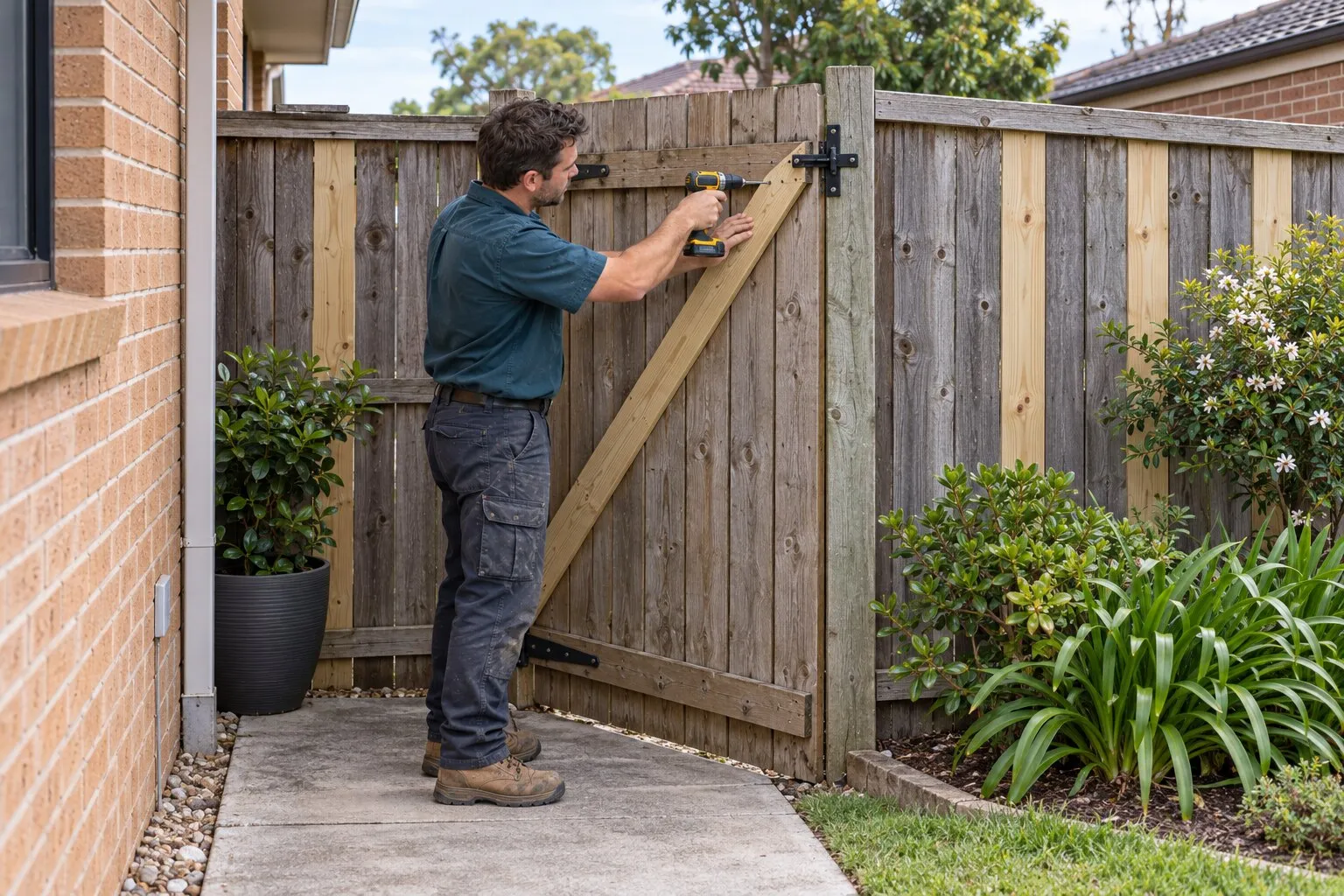
A timber gate usually drops at the latch end. Check the top hinge first: tighten loose screws, replace stripped ones with longer screws into sound timber, and replace bent hinges. A diagonal brace running from the bottom of the hinge side up to the top of the latch side stops a ledged gate from sagging again.
If the gate still will not catch, the latch and keeper have drifted apart. Moving the keeper is often enough. If the hinge post itself leans or moves when you push it, the post footing has failed. That is fence-post work, not a latch adjustment.
- Gate drags on the path: lift and re-fix at the hinges, then add or tighten a brace.
- Latch misses the keeper: re-align the keeper or replace a worn latch.
- Post rocks or leans: the post needs repair or replacement by a fencing contractor.
- A few broken palings on sound rails: replace like for like.
Check the fence before anyone cuts it
Older fences around Sydney include fibre cement sheet, often called fibro. The NSW Government lists fencing among the places asbestos is found in homes built before 1990, and advises not to sand, cut, drill or water-blast suspected asbestos. A broken fibro fence needs assessment and the right contractor, not a quick patch.
Pool gates and pool fences are safety barriers with their own rules. Do not adjust a pool gate’s hinges or latch as a general repair; use a specialist and keep the barrier secure in the meantime.
Fencing is a listed trade category in NSW, and residential building work valued over $5,000 including labour, materials and GST needs a contractor licence. A latch and a few palings sit well below that. A new boundary fence often does not, and it may also need council planning approval, so check with Canterbury-Bankstown Council before replacing one.
Getting a minor repair priced
Before asking for a quote, photograph the gate, both hinges, the latch and any damaged palings, and count them. Say whether the rails and posts are firm, whether you have matching timber, and how to get to both sides. If it is a shared fence, show your neighbour the photos and agree the repair first.
No published Sydney price covers small gate and fence repairs on their own. The handyman cost guide gives the published hourly and per-task benchmarks, and the door guide covers the same hinge-and-latch fixes inside the house.
This service covers minor, non-structural work. Residential building jobs are limited to $5,000 in total, including labour, materials and GST. Electrical, plumbing, gas and other specialist trades are outside this service. The limit applies to the whole job; work cannot be split into smaller invoices to avoid licensing. NSW licensing rules.
Questions about this guide
Do neighbours have to split the cost of a fence in NSW?
Legal Aid NSW says the Dividing Fences Act 1991 requires owners to share the cost of building, repairing or replacing a sufficient dividing fence, with exceptions such as where one owner damaged it.
What if my neighbour won’t pay for the fence?
Serve a written fencing notice. NCAT says it must be served at least one month before applying for orders. Legal Aid NSW says a fencing order can be sought from NCAT or the Local Court.
Who pays for my gate?
A gate on your own property, its hinges and latch, are generally your own repair. A gate built into a dividing fence is worth discussing with your neighbour.
I rent. Who fixes the back fence?
Report it to your landlord or agent. Fence disputes and cost sharing are between the owners.
Can a handyman fix a pool gate latch?
Pool gates are safety barriers. Use a pool barrier specialist and keep the area secure until it is fixed.
Sources and date checked
- Legal Aid NSW LawPrompt — fences, boundaries and retaining walls (Feb 2025)
- Legal Aid NSW — fences
- NCAT — dividing fences (updated 19 Jun 2026)
- NSW Government — asbestos safety in the home
- NSW Government — categories of building and trade work (modified 22 Sep 2026)
- NSW Government — getting repairs done in a rental
Information checked 13 October 2026. Guides explain the source’s published scope; a job needs its own assessment.