
The short answer
Walk the floor slowly and mark each squeak. Most come from a board that has come loose and rubs on its neighbour or its nail. A screw driven through the board into the joist below, pre-drilled and countersunk, then filled, holds it down far longer than powder brushed into the joint, which only quiets it for a while. Check for pipes and cables under the floor first. If the floor bounces, sags or slopes, the bearers, joists or stumps underneath may be the problem: that is a builder’s job. Airtasker publishes $200–$400 as the average cost of floor repair in Inner South West Sydney (updated 17 October 2026).
Why floorboards squeak
The Australian Timber Flooring Association says “many floors will make some noise when walked on”, and that in solid strip floors laid on joists or battens, squeaks come from “board-on-board rubbing or board-on-‘nail’ rubbing”. It adds that “often when squeaks occur the T&G joint is relatively loose”, and that some noises come from the subfloor framing or from boards rubbing against door joinery rather than from the flooring itself.
Timber moves with the seasons. Boards shrink in dry weather and swell in humid weather, which can loosen nails and open joints. Squeaks that come and go through the year often follow that cycle.
Find the squeak and the joist
Walk the room in socks and put a strip of masking tape on each spot that squeaks. Rock your weight on the spot: if you can feel the board move, it has come loose from the joist.
- Joist lines: the existing nail heads run in straight lines across the boards. Each line marks a joist.
- Underneath: if the house has a crawl space, look up from below while someone walks on the spot. You may see a gap between a board and its joist.
- Pipes and cables: before driving any screw, check underneath or along the joist line for water pipes and wiring that run close to the boards.
How to fix squeaky floorboards
These are the usual fixes, from the quickest to the most lasting.
- Powder in the joint: talc or similar brushed into the gap between two rubbing boards can quiet a squeak for a while. It does not stop the movement, so the noise tends to return.
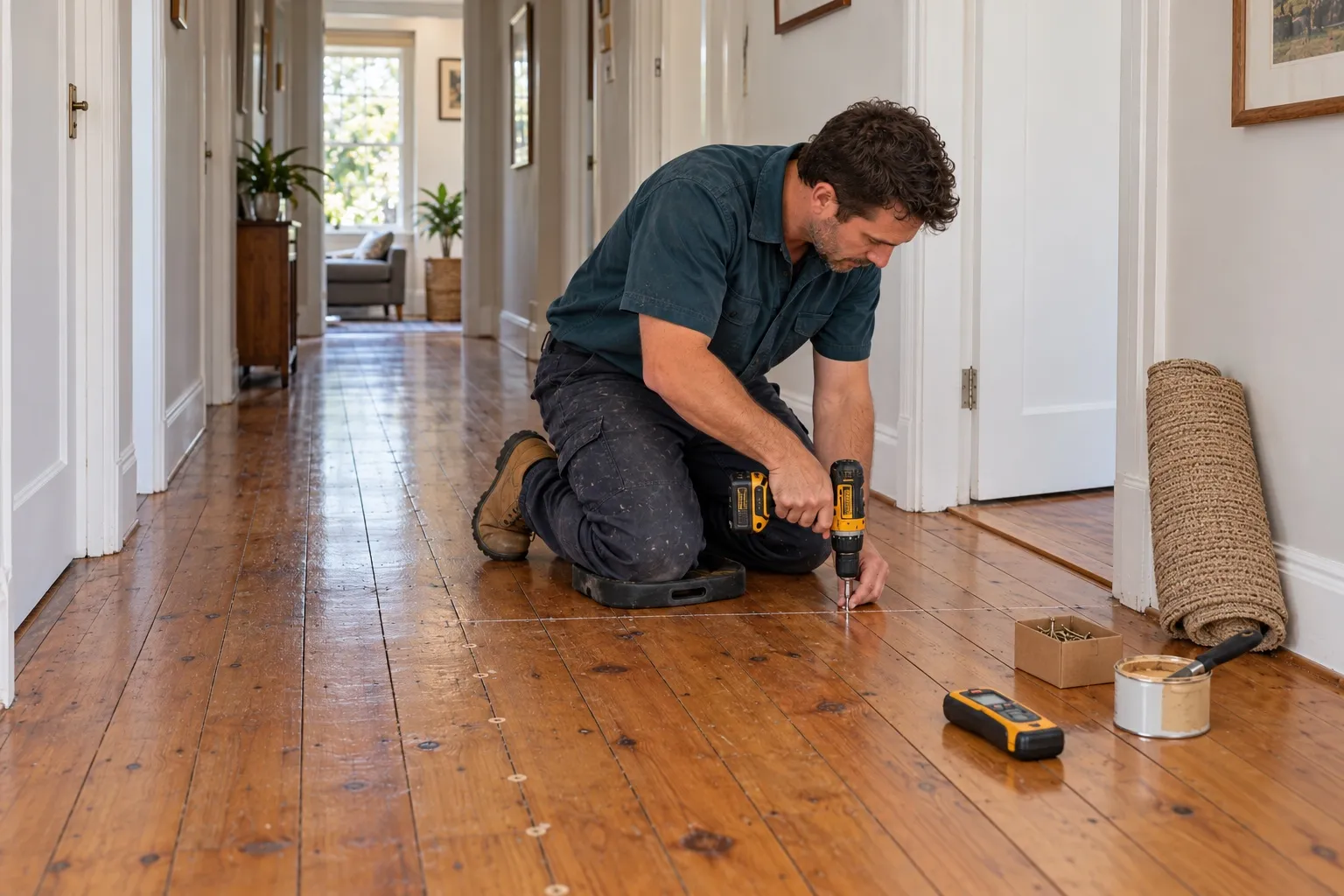
- Screw the board down: pre-drill through the loose board into the joist, countersink, and drive a flooring screw so the head sits below the surface. Fill the hole with matching timber filler. On a polished floor, line the screws up with the existing nails so they are hard to spot.
- Pack from underneath: where there is access below and a gap between the joist and the boards, a timber packer glued and tapped gently into the gap stops the board flexing without marks on top. Forcing a packer in can lift the board and leave a hump.
- Squeaks at a doorway or wall: where boards rub against door joinery or skirting, a little clearance or a refixed trim can stop the noise.
Fixing a few loose boards is a minor repair, but a polished floor shows every mark. Use filler matched to the timber, and test on a board in a cupboard or under furniture first.
What fixing squeaky floorboards costs in Sydney
We found no Sydney contractor price per board or per room for squeaky floors. Airtasker publishes average floor repair cost ranges for the area around Bankstown and for Sydney as a whole. Each is quoted separately as published.
Published floor repair prices
| Job or charge | Published guide | Publisher & scope |
|---|---|---|
| Floor repair | $200–$400 | AirtaskerAirtasker’s published average cost range for Inner South West Sydney floor repair (median $275); unit and number of jobs not stated; page last updated 17 October 2026; GST not stated |
| Floor repair | $220–$398 | AirtaskerAirtasker’s published average cost range for Sydney floor repair (median $295); unit and number of jobs not stated; page last updated 17 October 2026; GST not stated |
AUD figures as published, checked 22 October 2026. Third-party guides covering all kinds of floor repair, not quotes from this website. The number of squeaks, access under the floor and the finish change the price.
For a quote, say how many rooms or spots squeak, whether the floor is polished timber or covered by carpet, whether there is a crawl space underneath, and roughly how old the house is. Choose “Another minor job” on the quote form.
When a squeaky floor needs a builder
Loose boards are a minor repair. A problem in the frame under the floor is not. Have the floor inspected before fixing the surface if you notice any of these:
- the floor feels bouncy or springy, not just noisy
- a dip, sag or slope you can see or feel, or doors that start sticking in the same area
- boards that are soft, crumbling or hollow-sounding, or timber damage under the house
- stumps or piers that have sunk, leaned or cracked
Termites, stumps and bearers: who to call
Replacing bearers, joists, stumps or piers is structural building work, outside this minor-repair service. NSW lists underpinning and piering as its own trade category, and any residential building job over $5,000 including labour, materials and GST needs a contractor licence. For an inspection, the NSW Government suggests “a suitably qualified person such as a licensed builder, a surveyor or an architect”.
Timber that looks eaten or hollow may be termite damage. NSW guidance on inspection reports notes that a building inspection identifies visible termite damage but not whether termites are still active, so it recommends a pest inspection as well. Do not screw or patch over suspected termite damage.
In homes built or renovated before 1990, the NSW asbestos checker lists flooring among the places asbestos may be found. If there is old vinyl or sheet flooring, do not drill, cut or sand it until it has been tested.
This service covers minor, non-structural work. Residential building jobs are limited to $5,000 in total, including labour, materials and GST. Electrical, plumbing, gas and other specialist trades are outside this service. The limit applies to the whole job; work cannot be split into smaller invoices to avoid licensing. NSW licensing rules.
Questions about this guide
Why do my floorboards squeak?
Usually a board has come loose and rubs against the next board or the nail holding it. Seasonal shrinking and swelling of the timber loosens boards over time.
What is the best way to fix squeaky floorboards?
Screw the loose board down into the joist below: pre-drill, countersink, then fill the hole. Powder in the joint quiets a squeak only for a while.
Can I fix squeaky floorboards from underneath?
Where there is a crawl space, a timber packer glued into the gap between the joist and the boards can stop the movement without marking a polished floor.
How much does it cost to fix squeaky floorboards in Sydney?
Airtasker publishes average floor repair costs of $200–$400 in Inner South West Sydney and $220–$398 across Sydney (both updated 17 October 2026, GST not stated). These cover all kinds of floor repair.
Is a squeaky floor a sign of structural problems?
Not usually on its own. A floor that bounces, sags or slopes, or soft and damaged timber, needs an inspection by a builder, and a pest inspection if termites are possible.
Do squeaky floorboards need a licensed builder?
Screwing down a few loose boards is a minor repair. Replacing bearers, joists or stumps is structural work for a builder, and any residential building job over $5,000 needs a NSW contractor licence.
Sources and date checked
- Australian Timber Flooring Association — squeaking in solid and engineered flooring (no page date)
- Airtasker — floor repair in Inner South West Sydney (last updated 17 Oct 2026)
- Airtasker — floor repair in Sydney (last updated 17 Oct 2026)
- NSW Government — building and pest inspection reports (Sep 2025)
- NSW Government — how do I know if it's asbestos? (no page date)
- NSW Government — avoiding electrical accidents (Dec 2024)
- NSW Government — categories of building and trade work (modified 22 Sep 2026)
Information checked 23 October 2026. Guides explain the source’s published scope; a job needs its own assessment.